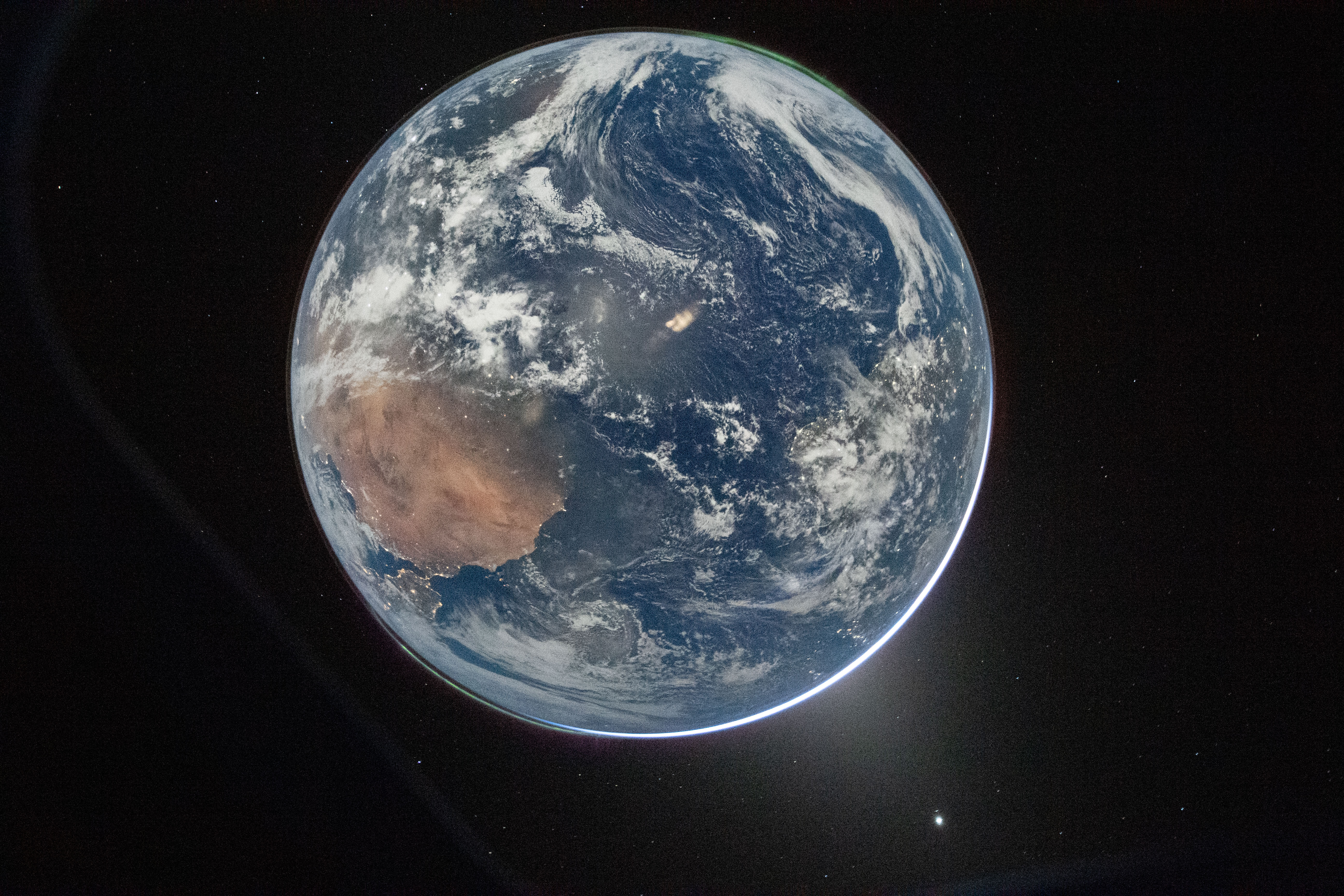
Image credit: NASA
How I Built a Space Mission Tracker, and Why It Matters
The Kid
I was maybe eight or nine when I first got stranded in space.
My dad and I were lying in my parents' bedroom, watching Apollo 13, the movie on TV. He was doing what he always did when we watched movies, describing everything I couldn't see and reading the subtitles aloud, because I didn't speak English yet. You couldn't pause live TV back then, so we missed things. A lot of things I wanted to know about. But the feeling, that cold anxiety of being lost between Earth and the Moon, tangled up with pure wonder about what exists beyond the sky, that got to me.
I could still see then, at least a bit. The daytime sky was a vast expanse of infinite blue, the sun, when it was present in the ever-cloudy Estonian sky, a distinct, blazing landmark. I, a 9 year old kid playing outside constantly, made my world revolve around where sun was in any given time of the day all the time.
I did live for the evening skies, just after sunset in June particularly. The Moon was a white dot to me on a good night. And the stars, I never saw the stars. Even on a deep August night when they say the night is white with starlight. But I likely was a great annoyance to the sighties around, I still am, asking whether there is a satellite they can see. Because they could.
The next morning after our movie night, I pulled up videos of Apollo 13 splashdown on what must have been one of YouTube's earliest days. I zoomed in as far as the player would let me and studied every frame. What colour is the capsule? Is it breaking apart? Are the pieces flying off of it burning? Oh it's not breaking apart at all, Why is the atmosphere purple? The sky isn't purple? What's that red thing, Aa, it's mars! No, it's the rocket… How does Earth look from out there? I sat there for hours, pulling details out of the grainy pixels.
That hunger for space and for the details never left.
In the years that followed, science fiction kept my longing alive. Arthur C. Clarke's 2001: A Space Odyssey doesn't just tell you about a ship moving through space. It tells you about the mechanics, the physics, the orbital calculations, the importance of mission control when the onboard computer fails, the vast emptiness and loneliness of space. Clarke understood that the thrill of spaceflight isn't in the spectacle. It's in the distance, in the details. The precise orbit, the burn duration, the… space. That's what has kept space real for me long after I stopped being able to see it.
The Adult
It was a regular Wednesday. April 1st, 2026. I had honestly forgotten.
In a few hours, four people are about to leave Earth's orbit for the first time in over fifty years, and I had forgotten. Not because I stopped caring. But somewhere between work emails, client deadlines, global disability advocacy policies, upcoming meetings, outgoing meeting notes, WhatsApp notes and “can you take a look at this real quick” messages and the relentless noise of a life that demands our attention for everything except what actually matters to me, the longing for space had gone quiet. I had reached a point in my life where even the things that define me couldn't compete with the next notification.
I don't really remember what broke through. A headline, a mention on the socials, something. But it did. I want to know what's happening out there.
So I sent a message to my AI assistant: “I want to build a mission tracking dashboard of Artemis II. How could I do that?”
By that evening, it was live.
The Nerd
Here's something sighted people might not expect: raw data is more vivid to me than any description anyone has ever given me.
When someone says “Orion is far away and getting smaller,” I get nothing. A sentence. I know it's getting away and probably smaller and “gosh, I know you almost can't see it any more.” When my tracker tells me the spacecraft is 274,000 kilometres from Earth, travelling at 3,840 km/h, decelerating towards the Moon, something in me puts it all in focus. I can compare that speed to a plane, to sound, to a rifle bullet. I can work out that a radio signal takes 1.8 seconds to reach the crew and come back. The numbers let me build my own picture.
You have photos from Orion's windows. You have NASA's stunning renders, the trajectory animations, the artist's impressions of Orion skimming the lunar surface. You can look at those and for a moment, imagine yourself floating out there. That's your way in.
Mine is the audio radar.
The audio radar sweeps across the stereo field, left to right, every few seconds, like a sonar pulse crossing the void between Earth and the Moon. Earth sits on the far left. The Moon on the far right. And somewhere between them, Orion. Its position in your headphones is its real position in space.
When Orion is close to Earth, its ping fires on the left, almost on top of Earth's chirp. As it coasts toward the Moon, the ping drifts rightward, sweep after sweep, further and further from home. Hour after hour, you can hear the bleep of Orion drift to the right, towards the Moon.
The audio radar is not just data. It is a place. Put on headphones and you hear Orion's double-beep slide across the stereo field, sweep after sweep, while the background hum shifts and darkens as the spacecraft slips behind the Moon and out of contact. Then silence. Then the ping comes back, faint, from the other side. Signal reacquired. It's a movie. Just told via sound, not via 3D graphics and fancy renders.
Sighted people imagine space by looking at images. I imagine space by listening to where things are. We end up in the same place. We just took different routes.
After I put the tracker online, I started hearing from sighted developers. One emailed me: “The value of your site is that it shows me the real numbers.” Not the graphs, not the visualisations, but the numbers. Turns out, when you build something accessible from scratch, you don't build a lesser version. You build a cleaner one. Faster, more direct, more honest. And everyone wants that.
The Bit That Isn't About Me
Most of the digital world is built for people who can see, hear, and click around with whatever pointing device they fancy. Accessibility, when it exists, is usually bolted on afterward by someone who has never heard a screen reader in their life.
The result is simple: people get locked out of information. Not because the data doesn't exist, but because someone put it in a chart with no text alternative. A colour-coded map with no labels. A drag-and-drop interface that a keyboard can't manipulate.
NASA publishes extraordinary real-time data during missions. But try following Artemis II with a screen reader. You'll find dashboards that trap your keyboard focus, visualisations that announce numbers without saying what those numbers are about, live streams with no captions. The information exists. The door is just locked.
Accessibility isn't a feature for a small group of people. It's the difference between experiencing one of humanity's greatest moments and being told about it later. Between being there and being narrated to.
It's easy, if you don't have a disability, to say that not everything can be made accessible right now. Easy to say: we'll get to it when we have the time, the resources, the budget. We'll add the description, the detailed, screen reader accessible graphs, machine readable data points later, after the mission. But what you're really saying is: you can wait. You matter less. Why? Why is your access to this moment more legitimate than mine? Why does my right to experience what's happening right now come with a disclaimer? Because there are fewer people like me than people like you?
Ok. Here's an actual disclaimer. NASA's content is phenomenal. They give us access to the public APIs, powering the exact website you are on right now. They describe their photos. They provide captions with their live streams. So, NASA, you're good.
But what about the rest of us creating the infrastructure and the tools around everything we can access?
Maybe the person who figures out the best trajectory to Mars is blind. Maybe the engineer who redesigns life support is in a wheelchair. Maybe the mission controller who catches the critical anomaly is deaf. You don't know. Nobody does. And every door you leave locked is a mind you'll never hear from.
The Kid.
I didn't build this to prove anything. I didn't build it to inspire anyone. I built it because I wanted to know where Orion was, and nobody was telling me in a way I could understand.
But if I'm honest, and look into myself, there's a wish after all.
Maybe, somewhere right now, a kid is sitting next to their dad, following the Artemis II mission. Maybe that kid can't see the screen. Maybe they've spent their whole life listening to other people describe what they're missing.
And maybe tonight, that kid opens the tracker, puts on headphones, and hears the audio radar ping stretching between the Earth and the Moon, as Orion drifts toward the Moon. And then they take the headphones off and hand them to their dad.
“Here. Listen. This is how I see it.”
Twenty years ago, my father gave me space with his voice. I'd like to think that somewhere tonight, a kid is giving it back.